

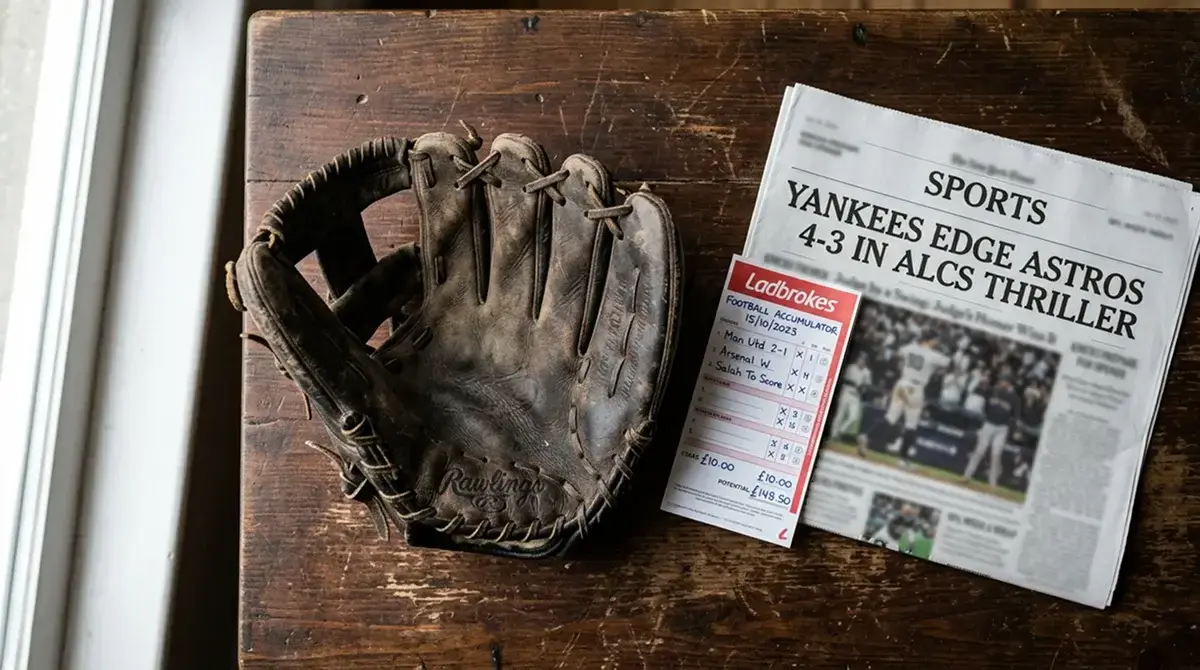
The first time I read a US baseball betting analysis, I genuinely thought I was reading a foreign language. Chalk. Dime lines. The juice. Fading the public. I knew what an accumulator was, what a handicap was, what a special was — but the American terms for those exact same concepts might as well have been Mandarin. Interest in baseball among British sports fans has grown from 4% to 5.9% in recent years, which means a wave of UK punters are hitting the same language barrier I did. This guide is the phrasebook I wish I’d had.
Translating US Odds and Formats Using MLB Betting Terminology
The biggest source of confusion is that the same bets go by completely different names on each side of the Atlantic. The UK market generates approximately 2.48 billion pounds in gross gaming yield annually, and nearly all of it uses a terminology set that diverges from the American standard in several key areas.
Parlay is the American term for accumulator. Same product: multiple selections combined into one bet, all legs must win. Americans call a two-leg parlay a “two-teamer,” a three-leg parlay a “three-teamer,” and so on. In the UK, you’d just say a double, treble, or four-fold. When US analysts talk about “parlay strategy,” they mean accumulator strategy. When they mention SGP (same game parlay), that’s a single-game accumulator — multiple selections from the same match.
Run line is baseball’s version of the handicap. The standard run line is ±1.5 runs — the favourite must win by two or more, or the underdog can lose by one and still cover. If you’ve bet Asian handicaps on football, the concept is identical; only the name and the fixed spread differ. Alternative run lines (±2.5, ±3.5) work the same way, just with a wider handicap.
Props is short for proposition bets — what UK bookmakers call specials or player performance bets. A prop can be anything from “Will Player X hit a home run?” to “Over/under 6.5 strikeouts for the starting pitcher.” The category is enormous in MLB: player props, game props, inning props, team props. UK bookmakers tend to list them under “Specials” or “Player Markets.”
Moneyline is the match result bet — picking which team wins. It’s the simplest MLB market: no handicap, no total, just a winner. UK bookmakers sometimes label it “Match Result” or “To Win Match.” The moneyline is the backbone of MLB betting, and the average favourite sits at around 1.70 decimal — roughly -142.6 in American odds.
Totals are over/unders on combined runs scored. Same concept as goals over/under in football, just with bigger numbers. A standard MLB total is 8.5 runs; a standard Premier League total is 2.5 goals. The mechanics and the mathematics are identical.
Baseball-Specific Terms Every Bettor Needs
Beyond the betting terminology, you need enough baseball vocabulary to understand what you’re actually wagering on. You don’t need to know every rule, but these terms appear constantly in analysis and matchup previews.
An inning is one round of play where each team bats once. A regulation game is nine innings — the away team bats in the top of each inning, the home team in the bottom. An at-bat is a single plate appearance by a batter against the pitcher. ERA (earned run average) is runs allowed per nine innings pitched — lower is better. A 3.00 ERA is excellent; a 5.00 ERA is poor.
The bullpen is the team’s group of relief pitchers — the men who pitch after the starter is removed. The closer is the reliever who pitches the final inning to protect a lead; the setup man pitches the eighth inning. When someone talks about “bullpen ERA,” they mean the collective performance of all relievers on that team.
A designated hitter (DH) is a batter who hits in place of the pitcher but doesn’t play a fielding position. Both leagues now use the DH. Pitch count is the number of pitches a starter has thrown — most managers pull their starter somewhere between 85 and 100 pitches, which is typically after five to seven innings. This directly affects when the bullpen takes over and is relevant for F5 (first five innings) betting.
The run line becomes much easier to understand once you know that roughly 30% of MLB games are decided by a single run. That context explains why the ±1.5 handicap carries such significance — it’s not a comfortable cushion. It’s a tightrope.
Betting Slang and Shorthand
American betting culture has its own slang that can throw UK readers off when browsing forums, Twitter, or podcast transcripts. Here’s the essential glossary.
Chalk means the favourite. “Betting chalk” means backing the favourite. Dog (or dawg) means the underdog. Juice (or vig) is the bookmaker’s margin — the overround in UK terminology. A dime line is a moneyline market with a ten-cent gap between the favourite and underdog juice (for example, -120/+110 instead of -125/+105). Dime lines are prized because they represent lower margin. Nickel line is the same concept but with a five-cent gap — even tighter margin.
A steam move is a sudden, sharp line movement caused by professional money hitting multiple sportsbooks simultaneously. Getting “steamed” means you placed a bet and then the line moved against you because of sharp action. NRFI and YRFI are no run first inning and yes run first inning — proposition bets on first-inning scoring. F5 means first five innings. Listed pitcher means your bet is void if the scheduled starter is replaced.
Square refers to recreational bettors; sharp refers to professionals. “Fading” means betting against — so “fading the public” means taking the opposite side of heavy public action. CLV (closing line value) measures whether you got a better price than the market’s final assessment. And when someone says a team “covered,” they mean it beat the handicap (run line) — a term borrowed from American football that applies identically in baseball.
